Signs A Storm-Damaged Tree Needs Immediate Professional Attention
Quick Answer: A tree that starts leaning after a storm needs a ground-level check within a day or two, not a wait-and-see approach. Look first at the soil around the base. Cracked, mounded, or lifted ground on the side opposite the lean means the root plate itself has shifted, and that calls for a same-day evaluation. A lean with no soil disturbance, an intact canopy, and no contact with a structure or power line can typically wait for a scheduled arborist visit within a week or two. Any leaning tree touching a power line needs a ten-foot clearance and a call to the utility company before anyone gets close, a distance set by federal workplace safety rules for exactly this situation.
The maple in the side yard stood straight through dinner. By the time the wind died down after midnight and the yard came back into view at first light, it was tilted a good fifteen degrees toward the fence, roots half-exposed on the uphill side of the lean where the soil had pulled apart in a jagged seam. That seam is the detail most homeowners walk right past on their way to look at the trunk. It is also the single most useful piece of information standing in the yard that morning.
A storm-caused lean is a different animal from the gentle, decades-old tilt many mature trees carry from growing toward available light. One developed slowly enough for the tree to compensate for it. The other happened in hours, sometimes minutes. We look at two things first on every storm call: how fast the lean appeared, and what the ground underneath it looks like. Reading those two signals correctly matters more than how dramatic the angle looks from the driveway.
Check the Ground Before You Check the Trunk
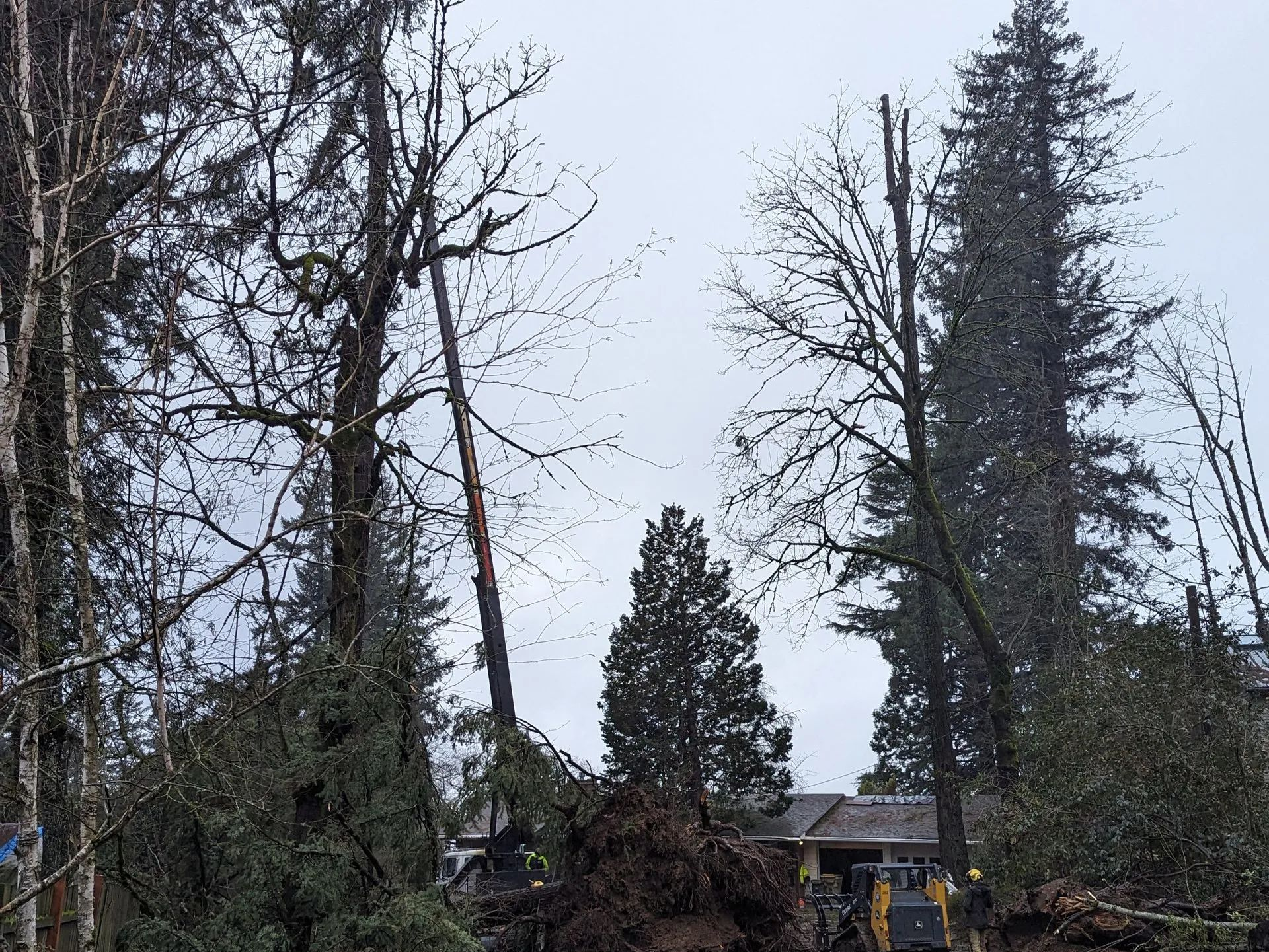
Most homeowners look at the trunk first. We look at the ground. When a tree's root system starts to fail under wind load, the root plate, the mass of roots and soil that anchors the tree, rocks rather than staying fixed. That rocking leaves physical evidence: soil cracked or separated on the side away from the lean, a ridge of lifted earth on that same side, and sometimes a shallow depression on the side the tree is falling toward, where the root plate has pressed down as it tips.
The International Society of Arboriculture's tree risk assessment guidance lists root plate lifting and soil cracking or heaving as one of the clearest field indicators that a tree has been rocking in high wind, and arborists are trained to check for it on every storm-related inspection. A university-published tree risk chapter used in professional arborist training programs describes the same pattern: heaving on the side away from the lean, paired with a compressed indentation on the side the tree is falling toward, as evidence that roots are actively pulling loose from the soil in response to wind load or root damage.
None of this requires special equipment. Walk a full circle around the base, looking at ground level rather than up at the canopy, and compare what you see to the soil a few feet further out. Fresh cracks. Soil pushed up rather than settled. Grass torn away from the roots underneath it. Any of those point toward a root plate still in motion. Dry, undisturbed soil around a tilted trunk tells us something very different, and it's usually a lower-urgency finding.
Why the Direction and the Speed of the Lean Matter
A tree that has leaned gradually for years has usually grown reaction wood, a denser band of wood tissue trees produce specifically to compensate for uneven stress, on the side of the trunk under compression. That adaptation is part of why old, naturally leaning trees can remain perfectly stable for a very long time. A tree that shifted overnight in a windstorm has had none of that time to compensate. The wood fibers and root system are reacting to a sudden load they were not built for in that direction, which is part of why a fast, storm-caused lean carries more immediate concern than an old, gradual one, even when the visible angle looks similar.
Speed matters as much as angle. A three-degree shift that happened over the course of one windstorm worries us more than a twenty-degree lean a tree has held, unchanged, for a decade. If you can point to the exact night the lean appeared, tell whoever evaluates the tree that detail first. It changes how we read everything else.
What a Leaning Tree Near Power Lines or Structures Requires
Proximity changes the calculus more than any other single factor. A leaning tree in an open corner of the yard, with nothing beneath it but lawn, is a lower-urgency situation than the same lean over a patio, driveway, or bedroom window. The tree's condition has not changed between those two scenarios, but what stands to be damaged if it fails completely has.
Contact with a power line moves a leaning tree into an entirely different category. Federal workplace safety standards set a minimum approach distance of ten feet from overhead power lines for anyone who is not a qualified line-clearance worker. Wood, wet bark, and damp ground can all conduct current from an energized line with no visual sign that it's happening. We won't touch a tree resting against a line, or one close enough that further movement could bring it into contact, until the utility company has cleared it. That rule doesn't bend for anyone, including our own crew.
Tip: Photograph the base of the tree and the surrounding soil the same day you notice the lean, from a few different angles, before rain or foot traffic disturbs the ground further. That record gives an arborist a clear before-and-after reference for judging whether the lean is holding steady or continuing to progress in the days that follow.
What a Professional Evaluation Actually Involves
We never evaluate a storm-caused lean from the driveway. A defect that's easy to see from one angle can be invisible from another, so we walk the tree from every side first. From there, we check the root plate and surrounding soil for the heaving and cracking signs already described, then the trunk for cracks, then the branch structure and canopy for damage from the same storm that caused the lean.
Sometimes trunks and root flares get a closer physical check with simple tools, since sound reveals hollow sections a visual inspection alone would miss. When that first walk-through raises real questions, we look more closely at the internal condition of the root system and lower trunk to see how much sound structure is left to work with. All of it feeds into one decision: can the tree's remaining structure reasonably hold it up going forward, or is removal the safer call before the next storm tests it again.
When a Leaning Tree Can Be Saved
Not every leaning tree needs to come down. The right response depends on the tree's size, species, and what actually caused the lean. Young trees with shallow, still-developing root systems often respond well to temporary staking that lets the trunk move slightly in the wind while the roots re-establish their grip. We remove that staking once the tree can stand on its own, since leaving it on too long interferes with normal root development.
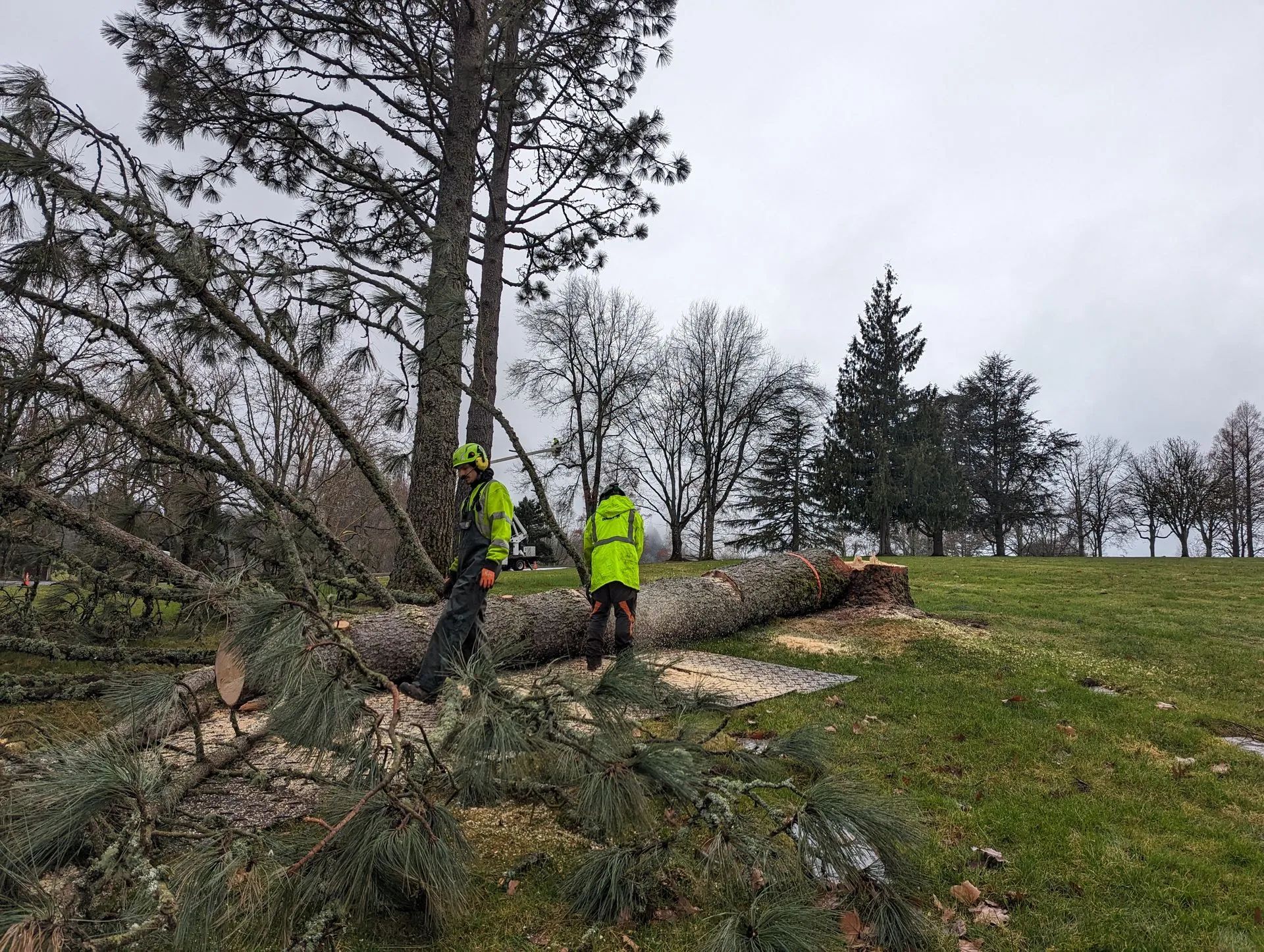
Mature trees are a different story. A large tree with a genuine structural concern, rather than simple root plate movement in otherwise sound soil, can sometimes be stabilized with cabling or bracing installed to accepted arboricultural standards, reducing stress on a weak union without requiring full removal. But that only makes sense once a real structural evaluation confirms enough sound wood and root structure remains to justify it. A tree with extensive root plate heaving, a trunk crack running across the grain, or major canopy loss on top of the lean has usually passed the point where cabling or staking changes anything. At that stage, we recommend removal, plainly, because it's the safer answer.
Warning: Do not attempt to pull, winch, or re-stake a mature leaning tree yourself, and never approach a leaning tree that is touching or near a power line. The combination of a compromised root system, an unpredictable center of gravity, and, in the case of power lines, a potential live current, has caused serious injuries even to people who were being careful. Keep the area clear and let a trained crew make the first assessment.
Signs the Lean Is Getting Worse, Not Better
A lean that appeared during a storm deserves a second look several days later, not just the first-morning assessment. Widening soil cracks, a root plate mound that has grown since the first check, new bark tearing at the base, or the tree settling further into its lean rather than holding steady are all signs the situation is still active rather than stabilized. A lean that has held at the same angle for a week, with no new soil disturbance and no fresh cracking anywhere on the trunk, is generally a more stable picture than one still visibly shifting day to day.
Documentation matters here too, beyond the tree itself. Photographing the lean, the soil condition, and any
storm damage creates a clear, dated record. That record can support an insurance claim if the tree eventually comes down or has already damaged something on the property. We build this kind of documentation into every evaluation we do, because a claim often comes down to proving when the damage happened and what caused it.
When Removal Is the Right Call
Can a leaning tree be pulled back upright and saved after a storm?
Sometimes, particularly with younger trees whose root systems are still developing and flexible enough to re-anchor once supported. Mature trees with a genuine root plate shift are different, and pulling one upright without evaluation can cause more damage.
How long is it safe to wait before having a leaning tree looked at?
A lean with active soil disturbance, contact with a structure, or proximity to a power line needs same-day attention. A lean with no ground movement and no nearby targets can wait a week or two.
What should I do if a leaning tree is touching or near a power line?
Stay at least ten feet back and keep everyone else away, including pets. Do not attempt to move branches or assess the tree yourself. Contact the utility company immediately for qualified assessment.
Does insurance typically cover a leaning tree that has not fallen yet?
Coverage varies by policy and by whether the tree has already caused damage. Documentation, including photographs taken soon after the storm and a written professional assessment, matters for how a claim gets handled.
How can I tell if a lean happened overnight or has developed over years?
A storm-caused lean usually comes with fresh, visible soil disturbance: cracking, mounding, or torn grass near the base. A long-standing lean typically shows smooth, settled soil and trunk thickening on the compressed side.
Is it safe to try straightening a small leaning tree myself?
For a young sapling with a small root ball, gentle re-staking is often within reach, provided stakes go outside the root zone. Anything larger, or showing root plate movement, is best left to a professional.
What The Ground Is Already Telling You
A tree leaning after a storm isn't asking anyone to guess. The soil, the trunk, and the canopy already show what that windstorm cost it structurally, and that evidence is usually readable within the first day or two if someone knows where to look. Checking the ground before the trunk, noting whether the lean is new or old, and keeping distance from anything near a power line covers most of what actually matters in those first critical hours.
Tree PNW
has spent 25+ years reading exactly these signs for homeowners across Portland, Oregon, where saturated winter soil and root diseases like laminated root rot make a sudden lean more urgent than it might look elsewhere. That experience is what separates a tree that can be staked or cabled back to stability from one that's already past the point where anything short of removal makes sense. What happens next depends entirely on what a closer look finds underneath.