What Happens During a Tree Removal, From Assessment to Cleanup
Quick Answer: Professional tree removal follows a set sequence: assessment of the tree and surrounding hazards, a removal plan based on available space, controlled cutting using directional felling or sectional dismantling, careful lowering or rigging of limbs and sections, and full cleanup, all handled with equipment and techniques matched to the tree's size, condition, and location relative to structures and power lines.
Watching a large tree come down in sections, one carefully placed cut at a time, looks almost effortless when a trained crew handles it. That impression is the result of a process built around assessment, planning, and controlled technique, not luck. Understanding what actually happens during a professional removal helps you know what to expect on the day of the job and why certain trees take a fraction of the time others do.
Step One: Assessing the Tree and the Site
Before any cutting starts, a trained eye evaluates the tree itself and everything around it. That means looking at species, trunk diameter, lean direction, root condition, and any visible signs of decay, disease, or structural weakness that might change how the tree behaves once cuts start. It also means walking the site to map out what's nearby: structures, fences, power lines, other trees, and how much open space is actually available for the tree or its sections to land.
This step determines everything that follows. A healthy, well-positioned tree with plenty of clear space around it might come down whole with a straightforward directional felling cut. A tree leaning toward a house, growing between two structures, or showing signs of internal decay changes the entire plan, often requiring the tree to be taken down in controlled sections instead of as one piece.
Reading the Lean and the Canopy
Trunk lean isn't always obvious from the ground, and canopy weight distribution can shift how a tree wants to fall independent of trunk angle. Most homeowners eyeball a tree and see a straight trunk. An arborist looks at where the canopy's weight actually sits, and that's often a different story. Knowing how a given species tends to behave under stress is part of what separates a controlled removal from a guessing game.
Step Two: Building the Removal Plan
Once the assessment is done, the plan gets built around the space actually available. In open yards with enough clearance, directional felling, cutting a notch on the side the tree should fall toward and a felling cut on the opposite side, lets the tree come down in one controlled piece toward a predetermined landing zone.
In tighter spaces near homes, fences, or other trees, that approach isn't safe or practical. Instead, the tree gets dismantled from the top down in sections, with each piece cut, controlled, and lowered before the next cut is made. This method takes longer and requires more equipment, but it's the standard approach whenever a whole-tree drop isn't a safe option given what's nearby.
Tip: If a tree on your property is leaning toward a structure, fence line, or neighboring yard, don't assume it has to come down as a single large piece. Sectional removal is a normal, controlled process built specifically for situations like that, and it's often the safer and more practical route even though it takes more time on site.
Step Three: Climbing, Rigging, and Cutting
For sectional removal, a climber (or in some cases a bucket truck, depending on access and tree height) works up into the canopy, securing themselves with climbing gear before making any cuts. Ropes and rigging equipment attach to limbs and trunk sections before they're cut free, allowing the crew to control the speed and direction of each piece as it comes down rather than letting it drop freely.
Working from the Top Down
Removal typically starts at the top of the canopy and works downward, taking off smaller limbs first before moving to larger sections of the trunk. This sequence keeps the tree's center of gravity more predictable as the job progresses and reduces the weight and size of what's being managed at any given point.
When a Crane Comes Into Play
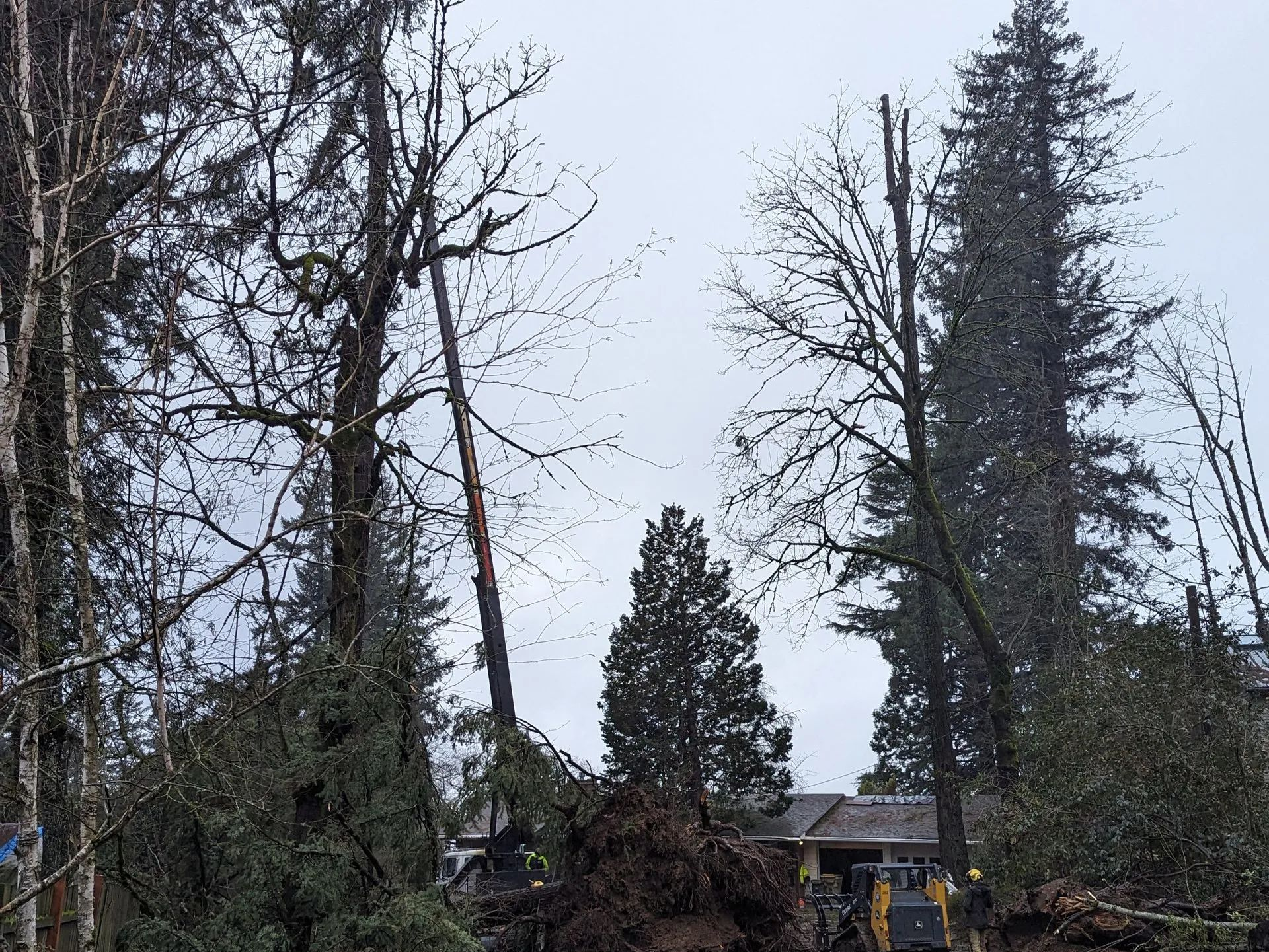
For especially large trees, tight urban lots, or situations where ground rigging isn't practical, a crane can lift and lower sections directly rather than relying on ropes and controlled drops from the canopy. This is more common on large removals or in yards where access for climbing and ground rigging is limited by fences, structures, or other obstacles.
Warning: Never attempt to remove a large limb or section yourself if a tree near your home shows signs of storm damage, splitting, or a sudden new lean after a windstorm. Trees under this kind of stress can behave unpredictably even with a clean-looking cut, and the risk to property and personal safety is far higher than it appears from the ground.
Step Four: Handling the Wood and Debris
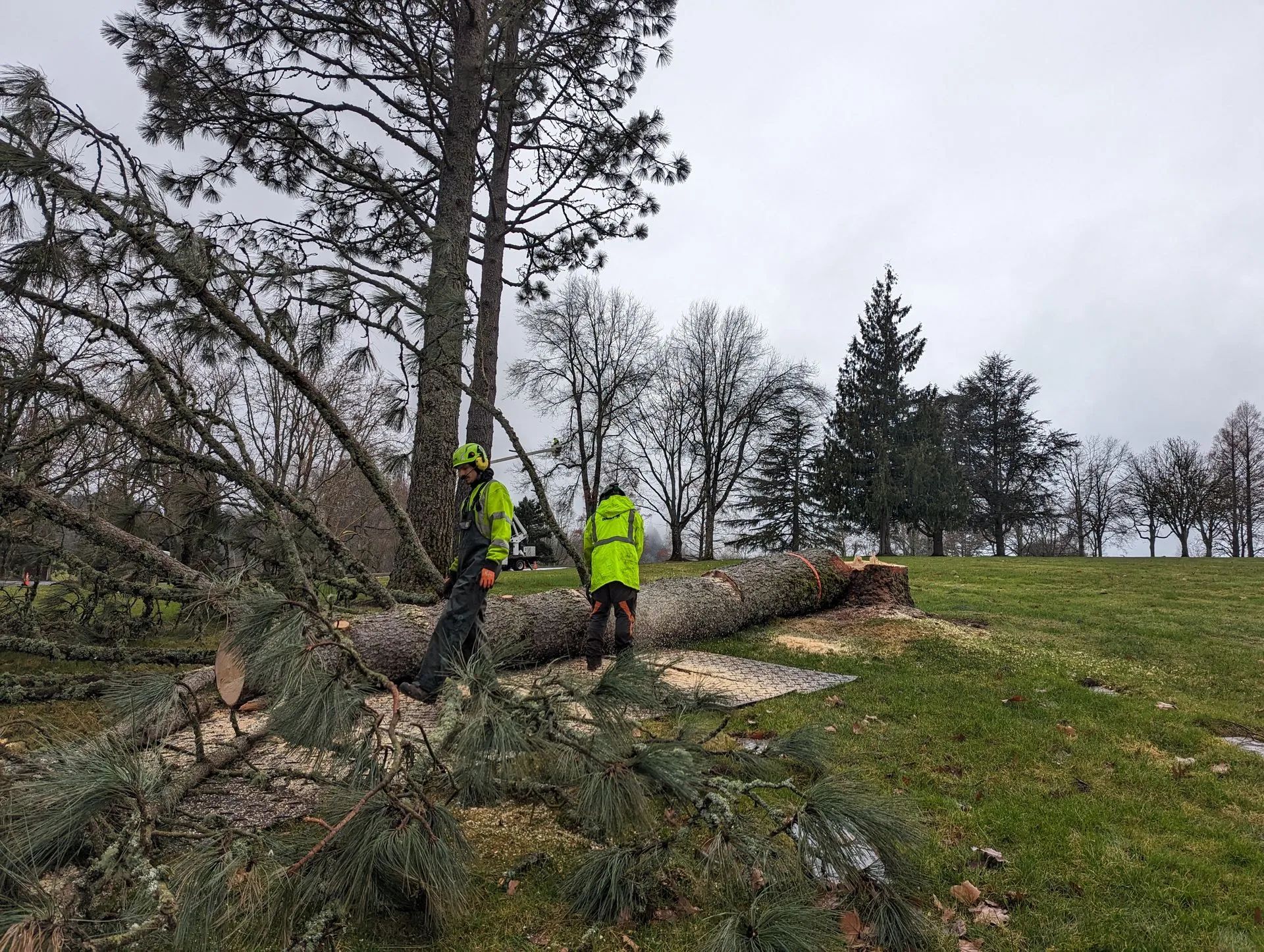
As sections come down, ground crew members move limbs and trunk pieces out of the working area, often feeding smaller branches through a chipper on site while larger trunk sections get bucked into manageable lengths. That work zone has to stay clear. Debris piling up underneath a crew still cutting overhead isn't a hazard anyone can afford to ignore.
Once the tree is fully down, a thorough site cleanup follows, clearing branches, chips, and debris from the yard, driveway, or street. What remains at that point is typically the stump, which is a separate service from removal itself and involves its own process of grinding the stump below grade.
Why Pacific Northwest Conditions Shape This Work
Root Rot in Saturated Soil
Portland's wet winters keep soil saturated for long stretches, which creates ideal conditions for root rot in species with shallower or more vulnerable root systems. A tree that looks structurally sound above ground can be hollowed out below it, roots weakened well past what the canopy lets on. That's exactly why the assessment step matters as much as the cutting technique. Removal crews look for signs like fungal growth at the base, soil heaving, or a trunk that shifts more than expected when pushed, all indicators that root integrity may not match what the canopy suggests.
Windstorms and Sudden Lean
Pacific Northwest windstorms can shift a tree's lean or create hidden stress fractures that aren't visible from a quick glance. Douglas firs and big-leaf maples, common throughout the Portland metro, can develop weak unions or co-dominant stems that become more likely to fail after repeated wind exposure, which is part of why post-storm assessments often turn up trees that need removal even though they looked fine the season before.
Tall, Dense Canopy Structure
Many mature trees in this region grow tall with dense upper canopies, which shifts more weight higher up the trunk than shorter, more open-canopy species in other parts of the country. This affects rigging plans and often means more sectional cuts are needed to safely bring the canopy down in manageable pieces rather than fewer, larger ones.
When Removal Is the Right Call
Removal isn't the default response to every tree issue. It typically comes into play when a tree is dead or dying, shows significant structural decay, has suffered storm damage that compromises its stability, is growing in a location where root or canopy conflicts with structures can't be resolved through pruning, or presents an ongoing hazard due to lean, root condition, or disease that pruning and treatment can't correct. An honest assessment weighs whether the tree can be preserved through treatment or pruning before removal becomes the recommendation.
When Removal Is the Right Call
How long does a typical tree removal take?
It depends heavily on tree size, location, and whether the removal needs to happen in sections versus a single directional fell. A straightforward removal in an open yard might take a few hours, while a large tree in a tight space requiring careful sectional work and crane assistance can take a full day or more.
Do you need to be home during a tree removal?
It varies by job, but having someone available to answer questions about site access, gate locations, or property details can help the process go smoothly, especially for larger or more complex removals.
What happens to the wood after removal?
Larger sections typically get cut into manageable lengths, and smaller branches usually go through a chipper on site. Arrangements for what happens to the wood, whether it's hauled away or left for firewood, are usually discussed as part of planning the job.
Is stump removal included in tree removal?
Not usually. Stump grinding is a separate step and often a separate service, since it involves different equipment and isn't always requested at the same time as the removal itself.
How do you know if a tree needs to come down versus just being pruned?
This comes down to an honest assessment of structural integrity, root condition, and how much of the tree's problem can realistically be corrected. Trees with isolated issues, like a single weak limb or minor deadwood, often just need pruning, while trees with significant trunk decay, major root loss, or an unsafe lean typically point toward removal.
Why Homeowners Choose All About Trees LLC
Every removal starts with reading the tree before touching it. We check species, lean, canopy weight, root condition, and what sits within reach of every section that comes down. With 25+ years of climbing, rigging, and felling behind us, we know which trees drop cleanly in one piece and which need careful sectional work from the top down. That kind of judgment protects your roof, your fence, and everyone standing on the ground while the saws are still running overhead.
Homeowners across Portland, Oregon call us when a windstorm leaves a new lean, when fungal growth appears at the base, or when a canopy simply outgrew the space around it. We walk the site, explain what the tree is actually doing, and tell you honestly whether pruning can save it or removal is the safer answer. If it comes down, we handle the rigging, the chipping, and the cleanup. Reach out to All About Trees LLC for a straight assessment.